SEO vs AEO vs GEO: What's the Difference? A Complete Guide for 2026
Introduction
The way people search for information online is changing. A few years ago, most users entered a keyword into Google, opened several websites, and compared the information themselves. Today, people also ask direct questions through voice assistants, AI-powered search platforms, and conversational tools.
For example, someone looking for an SEO tool might search Google for "best free SEO tools." Another person might ask a voice assistant, "Which free SEO tool can check my website?" Someone else may ask an AI platform to compare different SEO tools and recommend one.
Although these searches have a similar purpose, the way information is discovered and presented can be different.
This is where three important terms come into the discussion: SEO, AEO, and GEO.
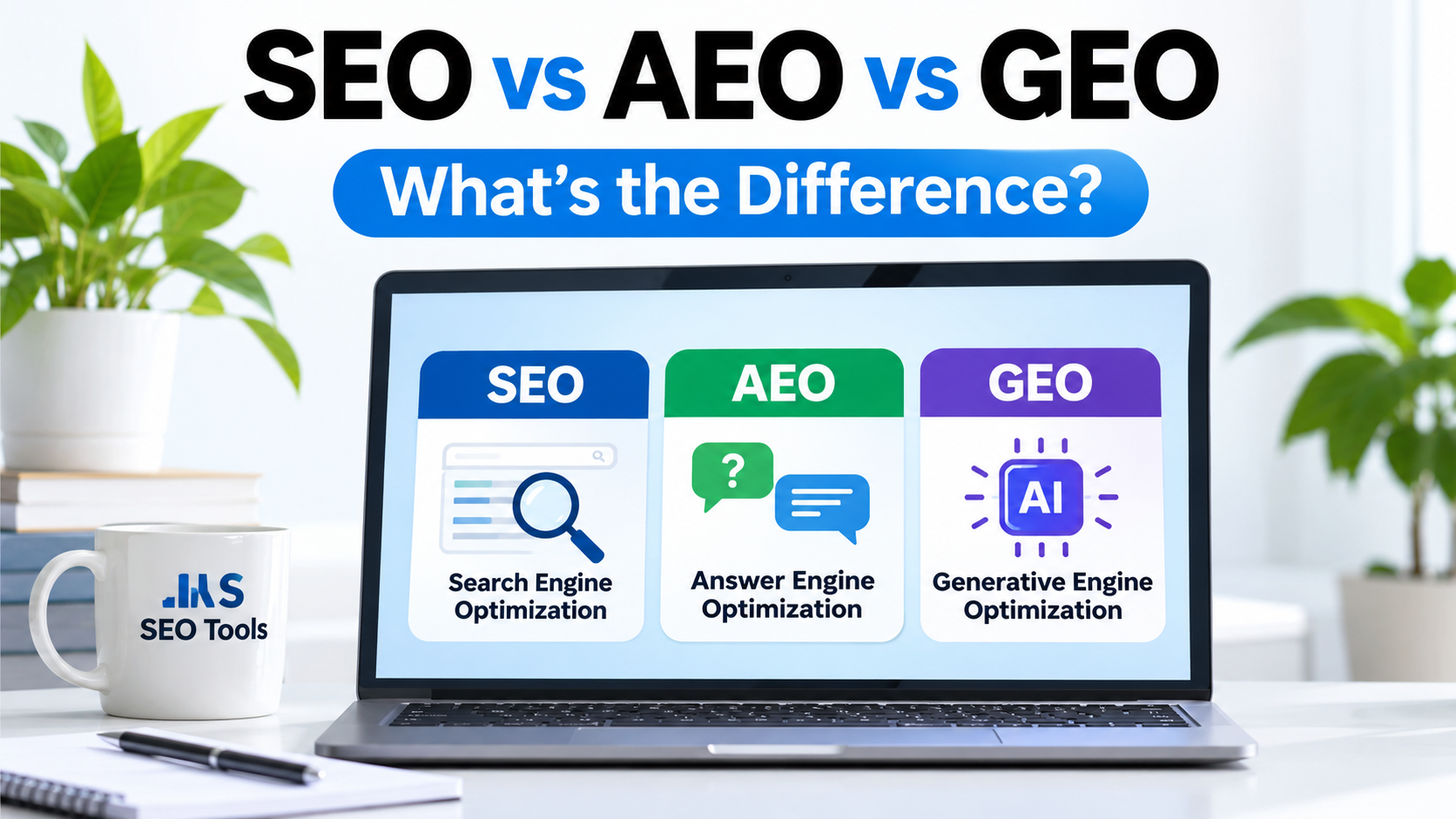
SEO stands for Search Engine Optimization. AEO means Answer Engine Optimization, while GEO means Generative Engine Optimization. All three focus on helping people discover useful information, but they approach search visibility from slightly different perspectives.
If you manage a website, publish blogs, or run an online business, understanding these concepts can help you prepare your content for modern search experiences.
In this guide, we will explain SEO vs AEO vs GEO in simple language, explore their differences, and discuss practical ways to improve your website's visibility.
What Is SEO (Search Engine Optimization)?
Search Engine Optimization, commonly known as SEO, is the process of improving a website so that its pages can be discovered and understood by search engines such as Google and Bing.
The main goal of SEO is to attract relevant visitors from unpaid search results. Instead of paying for every visitor through advertising, a website can earn organic visibility by publishing useful content and maintaining a technically accessible website.
For example, imagine you own a website that provides free SEO tools. You publish a detailed guide explaining how to perform a website audit. When someone searches for "how to audit a website," your article may appear in search results if search engines consider it relevant and useful.
SEO involves several important activities.
1. Keyword Research
Keyword research means understanding the words and phrases people use when searching online. It helps you create content that answers real questions.
For example, a website about SEO tools might target keywords such as:
Free SEO tools
Website SEO checker
Keyword research tools
Backlink checker
Website speed test
The goal should not be to repeat keywords unnecessarily. Instead, understand the search intent and create content that satisfies the user's needs.
2. On-Page SEO
On-page SEO focuses on improving individual website pages. It includes writing descriptive page titles, creating useful headings, organizing paragraphs, optimizing images, and adding relevant internal links.
A well-organized article makes it easier for visitors to understand the subject and navigate the information.
3. Technical SEO
Technical SEO focuses on the technical condition of a website. Search engines need to access and process your pages correctly.
Important areas include website speed, mobile usability, crawlability, indexing, HTTPS security, canonical URLs, XML sitemaps, and structured data where appropriate.
4. Off-Page SEO
Off-page SEO refers to activities outside your website that can help build its reputation and visibility.
Relevant backlinks, genuine brand mentions, digital public relations, and useful industry contributions can help people discover your website.
However, buying low-quality links or participating in manipulative link schemes can create problems rather than improve long-term performance.
What Is AEO (Answer Engine Optimization)?
Answer Engine Optimization, or AEO, is a term used for improving content so that answer-focused platforms can understand it and potentially use it when responding to users.
Traditional search often presents a list of webpages. Answer-focused experiences may provide a direct response to a question, sometimes with links to supporting sources.
For example, a user might ask:
"What is a meta description in SEO?"
A useful answer should explain the meaning clearly without forcing the reader to search through several unrelated paragraphs.
AEO encourages website owners to understand common questions and provide direct, accurate, and well-organized answers.
How Does AEO Work?
Answer engines need to understand the user's question and identify information that may answer it.
A page with clear explanations, descriptive headings, and relevant supporting information can be easier for both people and automated systems to interpret.
Consider an article about keyword research. Instead of only writing a long introduction, you could include a section titled "What Is Keyword Research?" followed by a short and accurate explanation.
You can then expand the topic with examples, tools, benefits, and practical instructions.
Important AEO Practices
Answer questions directly: Start question-based sections with a clear explanation before adding detailed information.
Use descriptive headings: Headings such as "How Does Keyword Research Work?" help readers understand what each section covers.
Include useful FAQs: Answer genuine questions that your audience is likely to ask. Avoid adding unrelated questions simply to include more keywords.
Use accurate information: Check facts, explain technical terms, and update outdated information.
Add relevant examples: Practical examples make complicated subjects easier to understand.
AEO is not a guarantee that an answer engine will select your website. It is a content approach that focuses on making useful answers easier to discover and understand.
What Is GEO (Generative Engine Optimization)?
Generative Engine Optimization, or GEO, is a term used to describe efforts to improve a brand's or website's visibility in AI-generated search and conversational experiences.
Generative AI platforms can create responses by combining information from different sources. Depending on the platform and query, they may also show links or references to webpages.
For example, a user might ask:
"Compare three free SEO tools for checking website errors."
An AI-powered search experience may provide a comparison, explain important features, and link to relevant websites.
A website that publishes original, accurate, detailed, and useful information may have opportunities to be discovered in these experiences.
How Does GEO Work?
Generative search systems can use different technologies to retrieve information, interpret questions, and generate responses.
Some systems use information from search indexes or other accessible sources to help ground their answers. The exact process differs between platforms.
This means website owners should focus on publishing information that is genuinely useful and easy to understand.
Important GEO Practices
Publish original information: Add practical knowledge, real examples, original research, or meaningful analysis instead of simply rewriting existing articles.
Build topical expertise: Cover important subjects related to your website's purpose. Connect relevant articles through useful internal links.
Keep information accurate: Check statistics, product details, technical instructions, and claims before publishing.
Use clear content structure: Organize articles with meaningful headings, paragraphs, lists, and tables where they improve readability.
Build a trustworthy brand: Make your website's purpose clear. Provide accurate contact information, author details where relevant, and transparent business information.
Support claims with reliable sources: When discussing research, technical standards, or changing information, link to credible references.
GEO should not be treated as a collection of secret tricks. Strong content and a reliable website remain more valuable than trying to manipulate AI-generated answers.
SEO vs AEO vs GEO: Key Differences
SEO, AEO, and GEO are related concepts, but they describe different ways of thinking about online visibility.
| Feature | SEO | AEO | GEO |
|---|---|---|---|
| Full form | Search Engine Optimization | Answer Engine Optimization | Generative Engine Optimization |
| Main focus | Search visibility | Direct answers | AI-generated responses |
| Typical experience | Search result listings | Question-and-answer responses | AI-generated summaries and recommendations |
| Content approach | Relevant, useful webpages | Clear answers to questions | Original, detailed, trustworthy information |
| Common optimization | Keywords, technical SEO, links | Direct explanations and FAQs | Unique insights, context, and reliable sources |
| Main objective | Attract relevant visitors | Make useful answers discoverable | Improve visibility in generative experiences |
The important point is that these approaches are not completely separate.
A well-optimized article can support all three goals. For example, a detailed guide with a descriptive title, helpful explanations, relevant examples, and a useful FAQ section can serve traditional search visitors and answer-focused experiences.
Real-World Example: SEO, AEO, and GEO for One Website
Let's understand the difference with a practical example.
Imagine you operate an online platform called NS SEO Tools that offers tools for website owners, bloggers, and digital marketers.
You publish an article about website speed testing.
SEO approach: You optimize the article for relevant searches such as "website speed test" and "how to check website speed." You create a useful title, explain the topic, improve internal linking, and ensure the page is accessible to search engines.
AEO approach: You add a clear explanation of what website speed testing means, how users can test a website, and what performance results indicate. You include relevant questions and direct answers.
GEO approach: You provide original testing examples, explain common performance problems, discuss practical solutions, and support important technical claims with reliable references. This gives readers more useful information than a generic definition.
One article can therefore follow SEO, AEO, and GEO principles without creating three separate versions of the same content.
How to Optimize Your Website for SEO, AEO, and GEO
You do not need three completely different content strategies. A better approach is to build one strong content foundation that serves visitors across different search experiences.
Here are practical steps you can follow.
Step 1: Understand Your Audience
Before writing an article, understand who will read it and what problem they want to solve.
For example, a beginner searching for "SEO tools" may need a simple explanation of keyword research, while an experienced marketer may want to compare technical features.
Create content according to the reader's actual needs instead of writing only to target search terms.
Step 2: Research Search Intent
Search intent means the purpose behind a user's search.
A person searching "what is SEO" probably wants an explanation. Someone searching "best SEO audit tools" may want a comparison. Someone searching for a particular tool may be ready to use it.
Identify the purpose of your target query and structure your content accordingly.
Step 3: Write Clear and Helpful Content
Start with a meaningful introduction. Explain the main topic, use relevant headings, and include examples wherever they make the subject easier to understand.
Avoid unnecessary repetition and keyword stuffing.
Every section should contribute something useful to the reader.
Step 4: Add Relevant FAQs
FAQs can help answer additional questions that readers may have.
For example, an article about GEO could answer:
Is GEO different from SEO?
Does AEO help with voice search?
Can small websites use GEO?
Does Google require special GEO markup?
Make sure the answers are accurate and directly related to the article.
Step 5: Improve Internal Linking
Internal links connect related pages on your website.
For example, an article about SEO vs AEO vs GEO could link to your guides about keyword research, website audits, technical SEO, and on-page SEO.
Use descriptive link text so visitors understand what they will find after clicking.
Step 6: Maintain Technical Website Quality
Make sure your website can be crawled and indexed where appropriate.
Check your robots.txt file, XML sitemap, canonical tags, mobile layout, HTTPS configuration, and page loading performance.
Use Google Search Console to monitor indexing and search performance.
Step 7: Add Trust and Original Value
Do not publish articles that only repeat common information.
Add your own examples, practical experience, screenshots, comparisons, testing results, and useful observations whenever possible.
Clearly identify authorship and review technical information before publishing.
Step 8: Measure and Improve
Publishing an article is only the beginning.
Monitor impressions, clicks, search queries, indexing, and page performance. Identify sections that are outdated or not answering readers' questions.
Update the article when meaningful new information becomes available.
Common AEO and GEO Mistakes to Avoid
As interest in AI search grows, many website owners are tempted by shortcuts. Some of these practices can waste time or damage content quality.
Avoid these common mistakes:
1. Publishing AI-generated articles without review: Automatically generated content can contain incorrect or misleading information. Always review facts, examples, and technical claims.
2. Keyword stuffing: Repeating the same phrase unnaturally makes content difficult to read.
3. Creating unnecessary FAQ sections: FAQs should answer genuine questions, not exist simply to increase word count.
4. Publishing multiple pages with almost identical information: Create separate pages only when they serve distinct user needs.
5. Using fake statistics or unsupported claims: Never invent research findings, customer results, or performance figures.
6. Believing in guaranteed AI citations: No legitimate SEO strategy can guarantee that an AI platform will mention or cite a particular website.
7. Ignoring technical SEO: Helpful content still needs to be accessible and eligible for search discovery.
Does Google Support SEO, AEO, and GEO?
Google continues to emphasize foundational SEO practices for its AI-powered search experiences, including AI Overviews and AI Mode.
Google's guidance explains that there are no additional special optimization requirements or dedicated schema types needed to appear in these AI experiences. Pages must meet the relevant Search technical requirements and remain eligible to appear in Google Search.
Google also emphasizes helpful, reliable, people-first content, clear technical structure, and original value.
This is an important distinction: AEO and GEO are useful industry terms for describing content strategies, but they should not be treated as separate Google ranking systems with guaranteed results.
For website owners, the practical lesson is simple: build a technically accessible website, publish original and useful content, and make information easy for visitors to understand.
Frequently Asked Questions (FAQs)
1. What is the main difference between SEO, AEO, and GEO?
SEO focuses on improving visibility in search engines. AEO focuses on making content useful for answer-based search experiences. GEO focuses on improving visibility in generative AI experiences. All three can benefit from clear, accurate, and helpful content.
2. Is GEO replacing traditional SEO?
No. GEO is not a replacement for SEO. Search engines and AI-powered search experiences still depend on discovering and understanding useful information. Traditional SEO fundamentals remain important.
3. Is AEO important for small websites?
Yes. Small websites can benefit from answering specific questions clearly and accurately. Focus on topics where you have genuine knowledge and can provide useful information to your audience.
4. How can I optimize my website for AI search?
Publish original and helpful content, organize information with clear headings, maintain technical accessibility, use relevant internal links, and support important claims with reliable sources. There is no guaranteed method to appear in every AI-generated answer.
5. Does Google require special GEO schema markup?
No. Google's guidance does not require special schema markup for inclusion in AI Overviews or AI Mode. Use structured data when it is appropriate for your content and follow the relevant Google guidelines.
6. Do FAQs improve SEO rankings?
FAQs can make an article more useful by answering related questions. However, adding FAQs does not automatically improve rankings. Their value depends on whether they genuinely help readers.
7. Can AI-generated content rank on Google?
AI-assisted content can appear in Google Search when it provides value and follows Google's policies. Automatically generating large amounts of low-value content to manipulate rankings can violate Google's spam policies. Accuracy, originality, and usefulness matter.
8. What is the best strategy for SEO, AEO, and GEO?
Build a strong website, understand your audience, create useful content, answer relevant questions, maintain technical SEO, and regularly improve your pages. Focus on helping visitors rather than trying to exploit search algorithms.
9. Does GEO guarantee visibility in ChatGPT or other AI platforms?
No. Different AI platforms use different systems and sources. Even excellent content cannot guarantee a mention, recommendation, or citation.
10. Which is more important: SEO, AEO, or GEO?
For most website owners, foundational SEO should remain the starting point. Clear answers and original information can then help support AEO and GEO goals. The best strategy combines these approaches rather than choosing only one.
Final Thoughts
SEO, AEO, and GEO describe three perspectives on how people discover information online. SEO helps websites become visible in traditional search experiences, AEO encourages clear and useful answers, and GEO focuses on visibility in generative AI experiences.
However, successful website growth is not about chasing every new industry term. It is about understanding your audience, solving real problems, and providing information that people can trust.
If you run a blog, business website, or online SEO platform, start with strong SEO fundamentals. Make your content easy to read, answer important questions, publish original insights, and maintain a technically healthy website.
At NS SEO Tools, our goal is to help website owners understand SEO and improve their websites with practical resources and useful tools. Keep learning, test your pages, and focus on delivering real value to visitors.