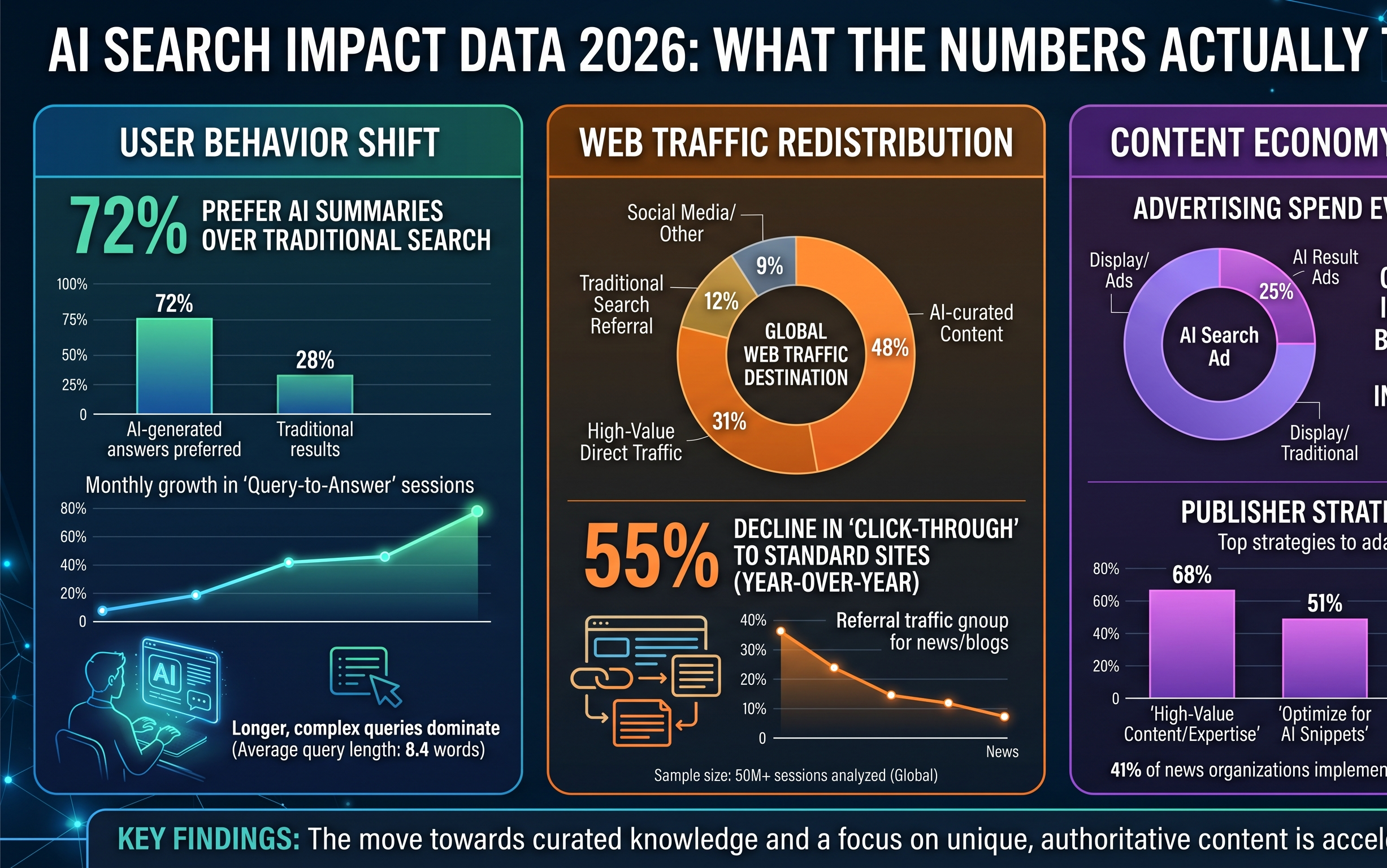
I still remember the first time a client called me, panicked, because their best-performing blog post lost half its traffic overnight. No penalty. No algorithm update they could point to. Just... gone. Turns out Google had started showing an AI Overview above their listing, and people stopped clicking. That was 2025. Today, in 2026, this isn't a rare story anymore. It's the new normal, and the AI search impact data backs it up with numbers that are honestly a little uncomfortable to read.
If you run a website, write content for a living, or manage SEO for a brand, you've probably felt this shift even if you haven't seen the stats yet. This article breaks down what's actually happening with AI search impact data right now, why it matters more than another algorithm tweak, and what you can realistically do about it.
What Is AI Search Impact Data?
AI search impact data refers to measurable statistics showing how AI-generated answers, like Google's AI Overviews, ChatGPT, and Perplexity, affect website traffic, click-through rates, and search visibility. It tracks how often AI summaries appear, how much they reduce clicks to websites, and which brands still get noticed despite the shift.
The Real Problem Nobody Warned Us About
Here's the thing. For years, ranking number one on Google was the holy grail. You'd pour months into backlinks, keyword research, and content polish, all chasing that top spot. And it worked. Position one used to pull roughly 28% of all clicks.
That math doesn't hold anymore.
When Google shows an AI Overview above the search results, organic click-through rate for that top position has dropped by 32% year-over-year, according to GrowthSRC's analysis of over 200,000 keywords. Position two lost almost 39%. These aren't small dips. They're the kind of numbers that make a finance team start asking uncomfortable questions in quarterly meetings.
Picture a small business owner named Priya who runs a handmade jewelry blog. She spent two years building authority around "how to clean silver jewelry at home." She finally hit position one last spring. Three weeks later, Google added an AI Overview that answered the question in four bullet points. Her traffic from that keyword fell by more than half, even though her ranking never changed. That's the silent damage AI search impact data is exposing across the web.
The Numbers That Matter Most
Let's get specific, because vague warnings don't help anyone make decisions.
Seer Interactive tracked 3,119 informational queries across 42 organizations between June 2024 and September 2025. Organic CTR on queries with AI Overviews crashed from 1.76% to 0.61%, a 61% decline. Paid CTR fell even harder, dropping 68% in the same window. If you were running ads expecting a certain return, that's the kind of shift that wrecks a budget forecast.
AI Overviews aren't a fringe feature anymore either. As of early 2026, they appear on roughly 48% of all Google search queries, according to BrightEdge tracking, up from just 31% the year before. For specific industries, it's even more intense. Healthcare queries trigger AI Overviews 88% of the time. Education sits at 83%. If your business lives in either space, you're already deep in this reality whether you've noticed or not.
Here's where it gets interesting though, and this is the part most articles skip. The decline didn't just keep falling forever. Seer Interactive's most recent 2026 update found that organic CTR on AI Overview queries actually rebounded from a floor of 1.3% in December 2025 to 2.4% by February 2026. That's not Google reversing course. It's more like the market finding a new, lower equilibrium after the initial shock.
Why Some Brands Are Thriving Anyway
This is the part that should change how you think about content strategy. Brands that get cited inside an AI Overview earn roughly 35% more organic clicks than brands that aren't cited, even on the exact same query. Some analyses put that citation advantage closer to 120% more clicks per impression.
Read that again. Being mentioned by name inside the AI answer is worth more than ranking high and being ignored by it.
I've seen this play out with a client in the personal finance space. Two competing articles both covered "how to build an emergency fund." One ranked position three on Google. The other ranked position seven but was the source AI Overviews quoted directly, with a clickable citation link. The position seven article generated nearly double the traffic of the higher-ranked one. Ranking position used to be everything. Now, citation status might matter more.
How AI Overviews Actually Decide Who to Cite
So how does Google pick which sources to feature? Based on patterns across multiple studies, a few things stand out consistently.
Content with firsthand research, original data, or a tested framework gets cited far more often than generic explainer content. If your page just repeats what's already said elsewhere, the AI Overview can summarize it without ever sending a visitor your way. There's nothing unique left to extract.
Specific answers beat broad ones. A page that explains "AI Overviews reduce CTR" in general terms is easy to summarize and skip. A page that breaks down exactly how much CTR drops by industry, position, and query type gives the AI something concrete to quote, and gives readers a reason to click through for the full picture.
Freshness matters three times more than it used to for maintaining citations, according to recent SEO research. Quarterly updates aren't optional anymore if you want to stay in the citation pool.
Step-by-Step: Adapting Your Content for This New Reality
Step 1: Audit which of your pages already trigger AI Overviews. Use Google Search Console's new AI performance section, which separates AI Overview impressions from standard organic data. This tells you exactly where you're exposed.
Pro tip: Don't panic if a high-traffic page shows AI Overview exposure. Panic only if your CTR on that page has actually dropped without a corresponding rise in impressions.
Step 2: Add a tight, factual summary near the top of every key article. Write 50 to 70 words that directly answer the primary question, before any storytelling or background. This is the section AI systems are most likely to extract and cite.
Pro tip: Treat this summary like a featured snippet attempt, because in many ways, that's exactly what it is.
Step 3: Inject original data, not borrowed stats. Even small surveys, internal numbers, or a unique angle on existing data make your page harder to fully replace with a summary.
Pro tip: One proprietary chart or table can do more for citation odds than five more paragraphs of generic explanation.
Step 4: Strengthen E-E-A-T signals across the page. Real author bios, clear sourcing, and transparent methodology all increase the odds an AI system trusts your content enough to cite it by name.
Pro tip: A simple "About the Author" section with credentials genuinely moves the needle here. Don't skip it.
Step 5: Track share of voice, not just rankings. Start monitoring how often your brand appears inside AI answers across ChatGPT, Perplexity, and Google AI Overviews for your core topics. Several tools now offer this kind of tracking.
Pro tip: Even a manual monthly check, just asking ChatGPT your top ten target questions yourself, gives you a rough but honest signal.
Common Mistakes I See Brands Make
The biggest one? Treating this like a temporary dip and waiting it out. It isn't temporary. Gartner has projected a 25% decline in traditional search volume by 2026, with some verticals seeing 30 to 50% reductions by 2028. Waiting only burns time you could spend adapting.
The second mistake is chasing AI citation across every single page. That's exhausting and unnecessary. Focus on your revenue-linked pages first, comparisons, pricing breakdowns, and category pages where being cited or clicked actually moves the business forward.
The third mistake, and this one's sneaky, is ignoring non-AI-Overview queries. Search Console data shows organic CTR on queries without AI Overviews climbed from 2.8% in January 2025 to 3.8% by February 2026. These are the topics Google hasn't figured out how to summarize cleanly yet. That's a real opportunity window, and it's quietly closing as AI Overview coverage keeps expanding.
Quick Wins You Can Start Today
Update your three highest-traffic informational pages with a tight answer-first summary this week, not next quarter. Add or strengthen author bios on anything that touches expertise-sensitive topics like health, finance, or legal advice. Check Search Console's AI performance report once this month, even if just to get familiar with the layout before you actually need it. And start a simple spreadsheet tracking which of your top ten target questions get you cited in ChatGPT or AI Overviews right now, so you have a baseline to measure against later.
Frequently Asked Questions
Is AI Overview killing SEO completely? No, I don't believe it is. I think SEO is splitting into two related disciplines instead of dying. Traditional ranking still drives meaningful traffic for commercial and transactional searches. What's changed is that informational content now needs a second strategy layered on top, one focused on earning citations inside AI-generated answers.
Should I stop creating informational content since clicks are dropping? I wouldn't go that far. Informational content that's genuinely original, well-sourced, and frequently updated still earns citations and the click-through boost that comes with them. What I'd stop doing is publishing generic, surface-level explainers that add nothing the AI couldn't already summarize from five other sources.
How do I know if my content is being cited by AI systems? I check manually first, by asking ChatGPT and searching Google for my core target questions and noting whether my brand shows up as a source. For a more systematic view, Search Console's AI performance section and several third-party visibility tools now track this more precisely across platforms.
Does this affect every industry the same way? Not even close. Healthcare and education see AI Overviews on over 80% of queries, while entertainment sits closer to 37%. I'd recommend checking your own Search Console data by query category before assuming the averages apply directly to you.
Is it worth investing in GEO if I'm a small business? Honestly, yes, but selectively. You don't need an enterprise-level strategy. Start with your two or three highest-value pages, add original insight and a sharp answer-first summary, and measure the citation impact before expanding further.
Wrapping It Up
The AI search impact data for 2026 tells a clear story: clicks are down, but they haven't disappeared, and citation has become a currency of its own. Brands that adapt by adding original insight, tightening their answers, and tracking AI visibility alongside rankings are the ones still growing. The ones standing still, hoping this reverses on its own, are the ones losing ground every single quarter.
For more honest guides on AI, tech, SEO Tools etc., and digital tools, visit News Society — India's own AI and tech knowledge hub: 👉 https://www.newssocity.com/ 🚀
 Image to Base64
  QR Code Generator
  Article Rewriter
  Plagiarism Checker
  JSON Formatter
  Image Resizer